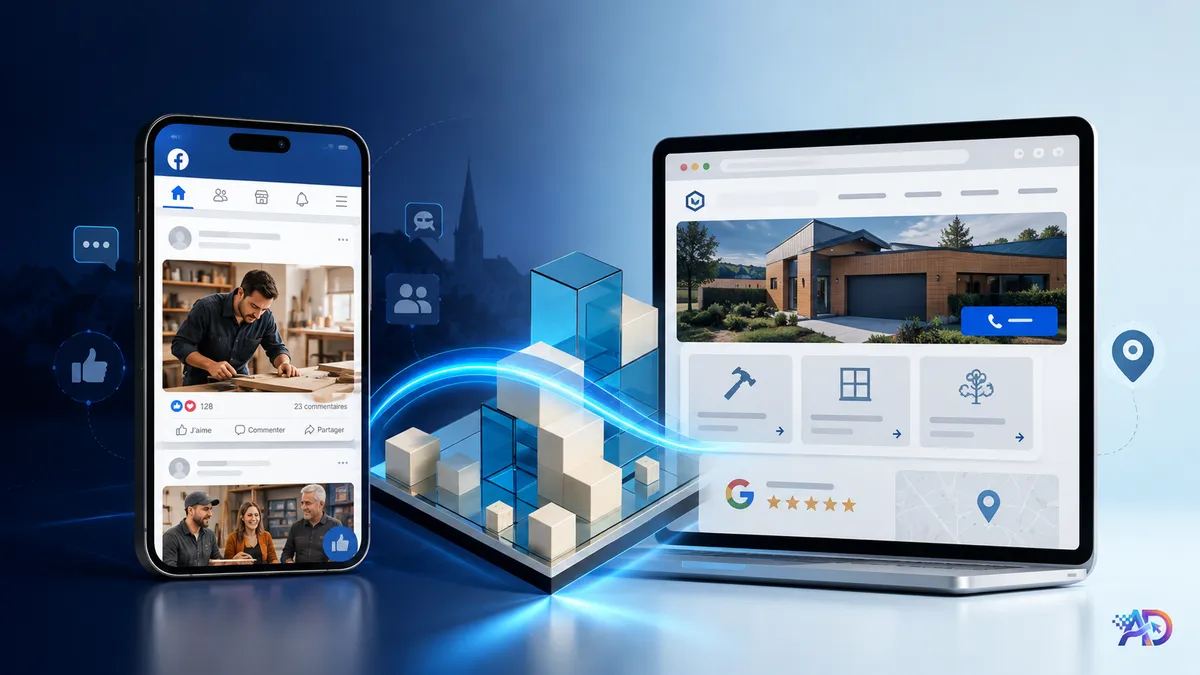
Many tradespeople and small businesses ask themselves the same question: do you really need a website when you already have a Facebook page?
The honest answer is: not always.
A Facebook page can work perfectly well for some activities. But as soon as a customer searches for you on Google, compares several professionals, asks for a quote, or wants to be reassured before calling you, a website can become very useful.
The most important thing is not to have “a website because you’re supposed to have one”. It’s to have an online presence that fits your activity, your customers, and the way you work.
What a Facebook page does well
Facebook remains an excellent tool for staying in touch with the people who already know you.
For a tradesperson, a shop, or an independent, a Facebook page lets you, for example:
- show a recent piece of work;
- announce something new, a closure, or a one-off offer;
- share before/after photos;
- reply quickly to a message;
- be visible in local groups;
- receive recommendations from customers or friends.
For a very local activity, with lots of word-of-mouth and little need to find new customers, that can sometimes be enough for a while.
A baker who works mostly on order, a home hairdresser whose diary is already full, or a builder who gets most of their jobs through recommendations doesn’t necessarily need a big, complicated website.
Facebook is lively, fast and practical. So the problem isn’t Facebook itself.
Where a Facebook page stops
A Facebook page is not entirely under your control.
Old posts disappear quickly down the feed. A future customer sometimes has to scroll through weeks of photos to find your opening hours, the area you cover, or the services you offer.
And above all, many customers don’t start their search on Facebook.
They type into Google instead:
- “plumber near me”;
- “air conditioning installer in my town”;
- “caterer for a birthday party”;
- “renovation contractor nearby”;
- “website for a small business”.
At that moment, they generally want to find clear information quickly:
- what you do;
- where you work;
- how to contact you;
- examples of your work;
- reviews or other signs of trust;
- a way to request a quote or book.
A Facebook page can contain that information, but it isn’t always the simplest way to present it.
It also depends on the platform’s rules, on how visible it decides to make you that week, and on whether the visitor uses Facebook at all. Some people don’t have an account, don’t want to log in, or simply prefer to look at a proper professional website.
What a website gives you on top
A website is your own space.
It can stay simple: a few well-built pages are often enough. The goal isn’t to create something heavy or complicated, but to answer your future customers’ questions clearly.
A good website can present:
- your services, clearly laid out;
- the area you cover;
- your work and project photos;
- your opening hours and contact details;
- a button to call you in one tap;
- a quote request form;
- online booking;
- your practical information and customer reviews.
It also connects your business better to Google, to your Google Business Profile, and to your social networks.
For example, a tradesperson working around Aigues-Vives, Vergèze, Codognan and Lunel — where we’re based, in the south of France — can explain their services and coverage area on one clear page. A customer looking for that service understands within seconds that they’re in the right place. The same logic applies to any town, anywhere.
A website doesn’t replace word-of-mouth. It completes it.
When someone gets your name through a recommendation, they’ll often look you up online before calling. A clear, professional website reassures that person and makes the first contact easier.
In short, here’s how the two complement each other:
| Website | |
|---|---|
| Post quickly | Present your services clearly |
| Talk with your community | Get found on Google |
| Show day-to-day life | Receive quote requests |
| Depends on a platform | Your own space |
In many cases, the most effective setup is: Facebook + Google + a simple website.
So, which one should you choose?
There is no single answer for everyone.
A Facebook page can be enough if:
- you already have enough demand;
- your activity relies almost entirely on word-of-mouth;
- you work very locally;
- you don’t want to grow your customer base right now;
- you have little information to present.
A website becomes more interesting if:
- your customers search for you on Google before contacting you;
- you offer services or quotes worth several hundred or thousand euros;
- you work across several towns or villages;
- you often get asked the same questions;
- you want to present your work better;
- you want to make quotes, calls or bookings easier;
- you want a more professional image, independent of social networks.
In many cases, the best solution is not to choose between Facebook and a website.
It’s to use both intelligently:
- Facebook to share, chat, and show the life of your business;
- Google to be found locally;
- your website to explain, reassure, and turn a visit into a first contact.
What you can do today
Before thinking about redoing your entire online presence, start by simply looking at your business through the eyes of a new customer.
Ask yourself:
- Can someone understand what I offer in under thirty seconds?
- Are my phone number and coverage area easy to find?
- Can a customer request a quote or book an appointment without difficulty?
- Do my photos really show the quality of my work?
- Do my Google listing, Facebook page and contact details all tell the same story?
- If someone searches for my activity on Google, do they find me easily?
You don’t need a complicated solution to answer these questions. Sometimes a better-filled Google listing, a clearer Facebook page, or a simple showcase website already makes a real difference.
The essential thing is to invest in what actually brings something to your business — not in an online presence built only “to look modern”.
To go further, see how a clear, well-fitted online presence can help your customers find you and contact you more easily.