The essentials in 30 seconds
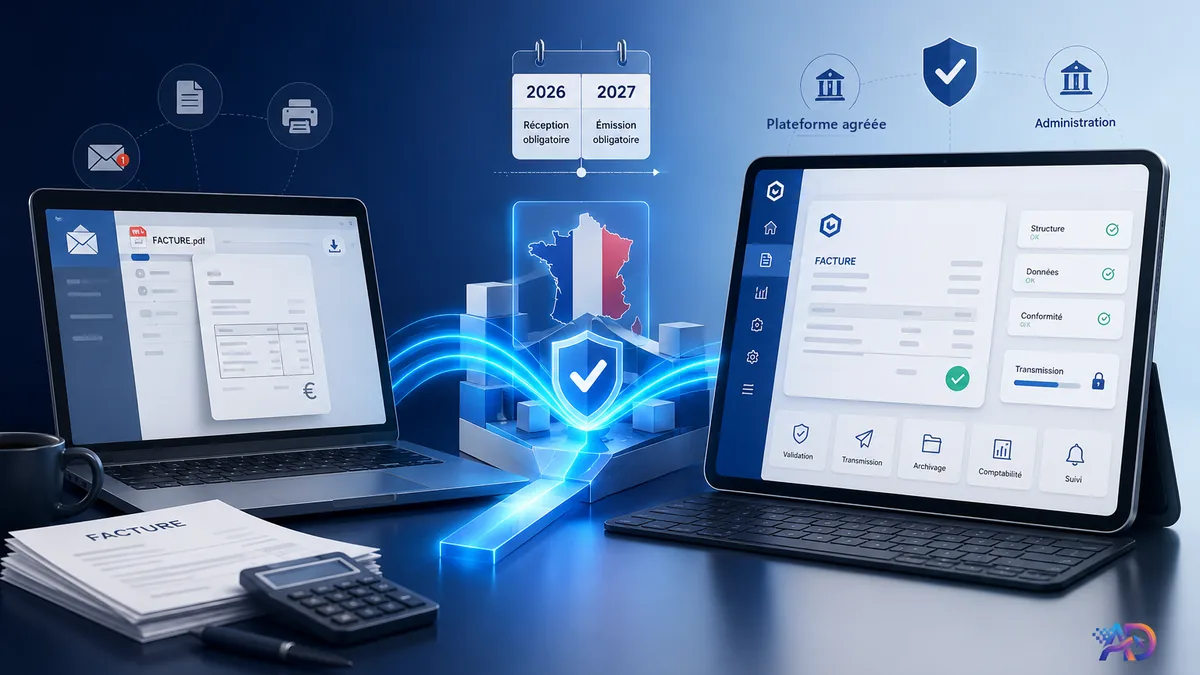
- 1 September 2026: every business must be able to receive electronic invoices.
- 1 September 2027: micro-businesses and small and medium-sized companies must also issue electronic invoices and transmit certain data.
- A simple PDF sent by e-mail will no longer count as an electronic invoice.
- Micro-entrepreneurs are concerned, even if they don't charge VAT.
- First steps: ask your accountant and your software provider.
Electronic invoicing is arriving progressively in France. Many tradespeople, freelancers, shop owners and micro-entrepreneurs have heard about it, but don’t yet know what will really change for them.
Will you have to give up PDFs?
Is an auto-entrepreneur concerned?
Do you need to buy new software?
And what is an “accredited platform” (« plateforme agréée »)?
The short answer is simple: yes, the reform concerns the vast majority of businesses, including micro-entrepreneurs. But that doesn’t mean everything has to change in a rush.
The goal of this article is to help you understand the next steps, before choosing a solution or signing anything.
The two dates to remember
For a small business, two dates matter most.
- 1 September 2026: every business must be able to receive electronic invoices from its suppliers.
- 1 September 2027: micro-businesses, small businesses and SMEs must also issue their invoices electronically in the cases concerned, and transmit certain transaction data to the tax administration.
Large and mid-sized companies switch to issuing as early as 1 September 2026. That is why even a very small structure must already be ready to receive their invoices on that date.
In short: in 2026, you must be able to receive. In 2027, small businesses must also be able to issue and report the data concerned.
An electronic invoice is not just a PDF sent by e-mail
This is probably the most important point.
Today, many businesses create an invoice as a PDF and send it by e-mail. That method remains practical for day-to-day work, but a simple PDF sent by e-mail will not be considered an electronic invoice under the new reform.
Why? Because a true electronic invoice must contain structured data that software can read automatically.
For example, the system must be able to clearly identify:
- the supplier;
- the business customer;
- the SIREN number;
- the amount excluding tax;
- the VAT;
- the date;
- the type of service or sale;
- certain information needed for regulatory transmission.
In practice, you won’t need to understand technical formats like Factur-X, UBL or CII. Your software or your platform will have to handle that for you.
What you should remember is simply this:
A PDF can remain a readable copy for you or your client, but the invoice will have to go through a compliant circuit and contain structured data.
Who is concerned?
The reform concerns VAT-registered businesses established in France.
That notably includes:
- tradespeople;
- shop owners;
- freelancers and independents;
- liberal professions;
- companies;
- associations with an economic activity;
- micro-entrepreneurs and auto-entrepreneurs, including those under the VAT exemption scheme (« franchise en base de TVA »).
In other words, not charging VAT does not automatically mean you are outside the system. A micro-business that writes “TVA non applicable, art. 293 B du CGI” on its invoices is generally concerned too.
Some very specific activities or operations may be treated differently. When in doubt, the right reflex is to check with your accountant or the official sources.
Electronic invoicing and e-reporting: what’s the difference?
The two notions are often mixed up, even though they don’t cover exactly the same thing.
Electronic invoicing
It mainly concerns invoices between French VAT-registered businesses.
For example:
- a tradesperson invoices a French company;
- an agency invoices a French SME;
- a supplier invoices a French shop.
In those cases, the invoice will have to go through an accredited platform, following the planned calendar.
E-reporting
E-reporting concerns the transmission of certain data to the tax administration when the sale does not fall under electronic invoicing between two French businesses.
It can concern, for example:
- sales to private individuals;
- sales to business customers established abroad;
- certain payment data, notably for services subject to VAT on receipt of payment.
Let’s take a few simple examples:
- A plumber invoices a French company: that falls under electronic invoicing.
- A hairdresser or a restaurant sells mainly to private individuals: they may be concerned by e-reporting.
- An online shop sells to individuals in France and abroad: it will have to check which flows must be transmitted.
- A French consultant invoices a foreign company: this is not the same circuit as an invoice between two French businesses, but certain data may have to be reported.
This does not mean that a private customer will suddenly receive a complicated electronic invoice. For the private customer, the invoice or receipt can continue to be delivered the usual way. The change mainly concerns how certain data is transmitted to the administration.
What is an accredited platform?
An accredited platform (« plateforme agréée ») is an intermediary recognised by the French tax administration to circulate electronic invoices and the data concerned.
It can notably allow you to:
- receive your suppliers’ invoices;
- send your business invoices;
- convert data into the right format;
- track the status of an invoice;
- transmit certain data to the administration.
You may still hear about “PDP”, an older term widely used for these platforms. The official term today is plateforme agréée — accredited platform.
You don’t need to create your own platform. In many cases, your invoicing software, your till system, your accounting software or your ERP will be able to become a solution compatible with an accredited platform.
So the right question to ask your provider is:
“Will your solution be an accredited platform, or will it be connected to one?”
Do you need to change software?
Not necessarily.
Some businesses already use invoicing, till, accounting, booking or sales-management software. In that case, simply ask the vendor how they plan to adapt.
Other businesses still invoice with Word, Excel, a manual PDF or a paper book. They will probably need to choose a more suitable solution before their issuing deadline.
That doesn’t mean you will necessarily need an expensive tool or a complicated setup. Depending on your needs, an accredited platform can offer a simple interface to create, send and receive invoices, sometimes with a basic service level designed for very small structures.
The most important thing is to choose a solution that fits the way you work, not an oversized one.
What you can do right now
You don’t need to wait until the last moment. But you don’t need to turn everything upside down this week either.
Here are the right steps to follow.
1. Look at who you invoice
Try to sort your customers simply:
- French businesses;
- private individuals;
- foreign businesses;
- public bodies and local authorities.
That first list already shows which flows concern you.
2. Ask your accountant
Your accountant knows your VAT regime, your activity and your invoicing habits.
You can ask them:
- which obligations will apply to my business;
- by what date must I be ready;
- is my current software suitable;
- do I need to choose an accredited platform;
- do I have to transmit payment or transaction data.
3. Contact your software provider
Whether you use invoicing, till, accounting, booking or quoting software, or an online shop, ask simple questions:
- will your solution be compatible with the reform;
- which accredited platform will it be connected to;
- will there be an extra cost;
- how will sales to private individuals be handled;
- how will online payments and deposits be handled.
4. Check your customer records
The reform makes data quality even more important.
For your business customers, make sure your information is clean and up to date:
- company name;
- address;
- SIREN number;
- delivery address, where relevant;
- payment terms;
- type of sale or service.
A small clean-up today avoids a lot of corrections tomorrow.
5. Identify the real journey of a sale
In some activities, a sale starts on a website, a quote form, a booking calendar, an online shop or a payment terminal.
Ask yourself one simple question:
At what moment is my invoice created, and which tool holds the right information?
This is especially important for online shops, businesses that take bookings, service activities with deposits, or businesses that still re-type the same data into several tools.
A few concrete examples
A tradesperson working mostly with private individuals
A builder, a gardener or a mobile hairdresser working mostly with private individuals won’t necessarily have to send a structured electronic invoice to every private customer.
However, they may be concerned by e-reporting, and they will have to be able to receive their suppliers’ electronic invoices from September 2026.
A consultant invoicing French companies
A consultant, graphic designer, agency or trainer who invoices French companies will have to be ready to issue electronic invoices by 1 September 2027 at the latest.
Their current software may well be enough, provided it is connected to an accredited platform.
A shop with a till and online sales
A business selling in-store, on its website and occasionally to professionals will have to check how its tools communicate with each other.
The risk is not only regulatory: without a clear organisation, you can quickly end up re-entering the same sales, payments or customer details several times.
A business working with a town hall or public body
Invoices for public bodies already have their own framework, notably with Chorus Pro.
If you work with a town hall, a group of municipalities, a school or a public body, ask your accountant or your software provider how the transition will be handled.
Mistakes to avoid
”I’m a micro-entrepreneur, so I’m not concerned”
That’s wrong in most cases. Micro-entrepreneurs are concerned, including those under the VAT exemption scheme.
”I already send my invoices as PDFs, so I’m ready”
Not completely. A PDF sent directly by e-mail does not match the definition of an electronic invoice set by the reform.
”I need to rebuild my website”
Not necessarily. Your website can keep presenting your services, receiving quote requests, taking bookings or selling your products.
What you need to check is the link between your website, your sales, your payments and your invoicing tool.
”My payment provider already handles everything”
A payment tool or an online shop does not automatically replace a compliant invoicing solution. You need to check what is actually planned for invoices and e-reporting.
”I have to choose a platform immediately”
There’s no need to panic, but you shouldn’t reach September 2026 without having asked the right questions.
The best time to start is now: understand your flows, question your tools and prepare your data.
What the reform does not change
Electronic invoicing does not force you to turn your business into an accounting department.
You will keep your way of working, your quotes, your payments, your customer relationships and the tools that serve you well. The change mainly concerns the circuit of certain invoices and the circulation of data.
The goal is for information to be more reliable, invoices to be better tracked, errors to decrease, and accounting to be fed more easily.
The right reflex is not to look for the most complicated tool. It is to choose a clear solution, compatible with your activity and with the tools you already use.
Should your website, bookings and invoicing be connected?
A website does not replace an accredited platform, invoicing software or an accountant.
However, when a business receives orders, bookings, deposits or quote requests online, it can be worth checking that information flows correctly between the different tools.
For example:
- a booking can create a quote request;
- an online deposit may need to be matched with an invoice;
- an e-commerce order may need to be passed to an invoicing tool;
- a business customer’s details may need to be captured correctly from the start.
That is where a clear digital organisation can prevent a lot of double entry and errors.
A question about your booking system, online shop or invoicing?
Adinav Digital Studio replaces neither your accountant nor an accredited platform.
What we can do is help you understand how your digital tools — website, bookings, payments, online shop, quote forms — can fit cleanly into the way you work, and automate certain administrative tasks without complicating your day-to-day.
Official sources (in French)
- Direction générale des Finances publiques — Je découvre la facturation électronique
- Direction générale des Finances publiques — Facturation électronique et plateformes agréées
- Direction générale des Finances publiques — Liste des plateformes agréées
- Direction générale des Finances publiques — Guide dédié aux micro-entreprises (PDF)
Information verified on 3 July 2026. Official rules and lists may evolve: always check your own situation with the official sources or your accountant.